Guides
Pet grooming operations: finding where a bad day breaks
Pet grooming operations troubleshooting: trace a slipping day to the station or handover behind it, from the dryer to intake, holding and the stop rule.
What to take away
- A grooming day is a relay, and a bad day usually shows up at a handover rather than inside a stage.
- Match the symptom to a station before changing the menu, the staff or the prices.
- The workflow pattern you run decides where the queue forms first.
- Drying sets the pace in almost every room, whatever the menu says.
- The stop rule is part of the workflow, written down and rehearsed, not improvised at the table.
Start from the symptom, then find the station
Ask an owner what went wrong on a bad day and the answer is usually a dog. Ask what the schedule looked like and the answer is usually two dogs needing the same dryer at the same time. Read the symptom first, because it points to a station.
| What you see | Station to check | What it points to |
|---|---|---|
| The groomer stands at the dryer instead of the table | Whole route, one person | One groomer is doing every stage |
| Wet dogs waiting | Drying positions | The bath end outruns drying capacity |
| Holding space filling | Holding | Finished dogs wait longer than planned |
| The day runs late every day | Intake and collection | These stages are not in the schedule |
| A finish that will not hold | Drying quality | The coat was dry on the surface only |
Work down the table in that order and stop at the first row that matches. Each of the next sections covers one of them.
Draw the route you actually run
A station is anything only one dog can occupy at a time: the tub, each drying position, each table, the holding space. An appointment is a route through them. Draw the route for your busiest coat family and mark every point where the dog is handed on.
Dog's route through stations
- Intake and coat check
- Tub
- Drying position
- Grooming table
- Holding space
- Collection
Those points are where the day is either fluid or stuck. A stage that runs long is annoying. A handover that cannot happen stops two appointments at once, which is the problem timing the grooms and counting the dryers is meant to prevent.
The room decisions behind the stations are set out in the equipment and setup guide.
Which pattern fails where
Three workflow patterns cover most salons, and each moves the queue to a different place. None is more professional than another. The right one is the one that puts the queue at the station you have most of.
| Pattern | Where it fails first | Who it suits |
|---|---|---|
| One groomer, one dog, start to finish | The groomer stands at the dryer instead of the table | A single operator or a mobile unit |
| Bather and groomer split | The bath end outruns the drying capacity | Two or more staff with enough dryers |
| Batch bathing, then table work | Wet dogs waiting, and holding space filling | Rooms with parallel drying and secure holding |
Three workflow patterns compared
One groomer
- How work moves
- Same person every stage
- Fails first
- Groomer at dryer
- Who it suits
- Single operator or mobile
Bather and groomer
- How work moves
- Bather wet end, groomer table
- Fails first
- Bath outruns drying
- Who it suits
- Two or more staff, dryers
Batch bathing
- How work moves
- Bathe several, then finish
- Fails first
- Wet dogs waiting
- Who it suits
- Parallel drying, secure holding
The handover at each end
Intake and collection are stages, not interruptions, so time them and put them in the schedule. A salon that treats these as free will run late every day and blame the grooming.
Intake and collection handover
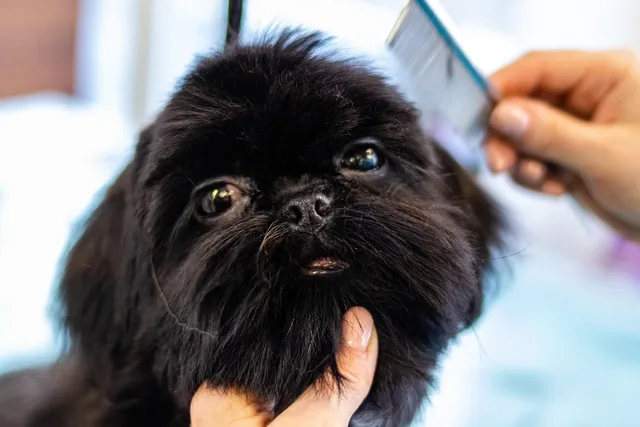
- Check coat with comb in front of owner
- Confirm agreed work
- Take intake photograph with owner's agreement
- Take matching collection photograph
- Close the record
At intake, the coat is checked with a comb in front of the owner, the agreed work is confirmed, and a photograph is taken with the owner's agreement. The intake form holds that record. At collection, the matching photograph is taken and the record is closed.
Write down who does the handover when the groomer is at the table. If the answer is nobody, the answer is the groomer, and the schedule has to say so.
Drying, the usual constraint
In most rooms the dryer is the constraint and the table gets the blame. A dog that cannot start drying holds the tub. A dog that cannot finish drying holds a groomer who should be scissoring.
Drying station rules
- Never leave dog unattended in heated drying
- Write procedure naming who watches
- State what stops the process
- Dry to the skin, not surface
- Confirm local rules with state and insurer
Two rules apply to drying, whatever the method. Never leave a dog unattended in a heated drying environment, and give every heat method a written procedure naming who watches and what stops the process.
Dry also means dry to the skin. A double coat dry on the surface produces a finish that will not hold and a return visit nobody billed for. Drying facility conditions vary by state and municipality, and insurers often add their own, so confirm yours with your state authority and insurer.
Holding, and when work stops
A finished dog waiting for collection occupies something. If that something is a grooming table, the table is out of the workflow. Give holding its own secure, non slip space, count it as a station, and check how long dogs actually wait.
In some jurisdictions, holding an animal for an extended period is treated differently from grooming it. Ask your state and municipal authority about your actual practice; the licensing and compliance guide covers how to record the answer.
The stop rule is used mid appointment, by whoever is holding the dog. Three cases trigger it:
- A coat matted to the skin, where the humane option is a shave down the owner has not agreed to
- A dog showing stress the handler cannot settle, or that cannot be restrained safely by the people present
- Anything visible on the skin, ears, feet or eyes that the groomer is not qualified to assess
In the third case the groomer records what is visible, tells the owner and refers them to a veterinarian. A groomer describes. A veterinarian assesses. Rehearse the wording, because the hardest part is saying it to a client who is in a hurry.
Records that make the next bad day easier
Keep the record short enough that it is actually filled in: coat condition at intake, the work agreed, the photographs, the time each stage started, anything refused, and the reason. Those lines show which menu line overruns, and they are the evidence if a collection is disputed.
The Occupational Safety and Health Administration's safety and health programs guidance gives a straightforward, stepwise approach that suits drying, restraint and blade procedures. The Bureau of Labor Statistics notes that workers risk injury when caring for animals, which is the reason those procedures are written down.
The capacity that all of this is bounded by is set out in the startup and market guide.
Common questions
How many dogs should be in the building at once?
As many as can move through the stations without two of them waiting on the same one. Count it from your drawing rather than from a target, and count it in the heaviest coat season.
Should a groomer bathe their own dogs?
In a single operator room there is no choice. Where there is a choice, splitting the wet end frees table time only if the drying positions can absorb what the bather produces. Otherwise the split creates a queue of wet dogs.
What is the first sign a workflow is failing?
Dogs waiting while people are busy. If staff are occupied and the book is still slipping, the problem is a station rather than an effort level.
How often should the workflow be reviewed?
At the turn of the heaviest coat season, and after any change to the menu or the room. Those are the two events that move where the queue forms.