Guides
6 lessons worth learning about pet grooming startup
Pet grooming startup planning turns on coat mix, station count and the work you agree to refuse, long before a price list or a national average matters at all.
What to take away
- A grooming business sells finished table hours, so the coat mix that walks through the door sets the revenue ceiling before any price is chosen.
- Four operating formats are common, and they differ most in what each one lets an owner decline without losing the day.
- Local demand is readable from your own booking attempts and from the reach of your service area, not from a purchased figure.
- Money is committed to the wet room, the drying setup and the table long before the first dog is booked, and those three shape every working day after.
- The list of work the business will not accept is a startup document, not an afterthought, because one bad hour eats a good week.
A groom is not one task. It is a sequence that occupies different equipment at different moments: intake and coat inspection at the counter, a bath at the tub, a stretch of drying, then table time for clipping, scissoring and finish work. Only the table stage holds a groomer's full attention for its whole length.
One salon can dry a heavy double coat while a smooth coated terrier is being finished on the table. Another dries in the same square footage it clips in, so the second dog waits.
What an appointment actually occupies
Sketch the working day as stations rather than as appointments. A station is anything only one dog can use at a time: the tub, each dryer position, each grooming table, the holding area. Then ask how many dogs can be inside the building at once without two of them needing the same station in the same minute.
Stations a dog occupies
- Tub
- Dryer position
- Grooming table
- Holding area
- Count dogs per station
That number is the first honest estimate of the business. It is also the number a lease, a van or a spare room either supports or quietly caps. Owners who plan in appointments per day rather than in stations discover the cap in week three, usually on a Saturday.
The four operating formats, compared
What it lets you refuse
- Home salon
- Nearly anything, because the calendar answers to nobody else
- Storefront
- Little, once the door is open and the hours are posted
- Mobile unit
- Distance, since travel time is visibly expensive
- Rented chair inside another business
- Whatever the host agrees to in writing
What it commits early
- Home salon
- Plumbing, drainage, and a room that can be washed down
- Storefront
- Lease, wet room build, drying capacity
- Mobile unit
- Vehicle, water carriage, waste handling, power
- Rented chair inside another business
- Hand tools and little else
Where it strains first
- Home salon
- Zoning permission and separation from household space
- Storefront
- Fixed cost that runs whether the table is full or empty
- Mobile unit
- Route density, weather, and parking
- Rented chair inside another business
- Dependence on somebody else's traffic and opening hours
None of these is the beginner's option. They are different bets about which constraint you would rather live with. A mobile unit trades station count for reach. A storefront trades flexibility for walk-past visibility. A rented chair trades control for a low commitment that can end on the host's notice.
Four operating formats compared
Home salon
- Can refuse
- Nearly anything
- Commits early
- Plumbing, drainage
- Strains first
- Zoning, household
Storefront
- Can refuse
- Little
- Commits early
- Lease, wet room
- Strains first
- Fixed cost
Mobile unit
- Can refuse
- Distance
- Commits early
- Vehicle, water, power
- Strains first
- Route, weather
Rented chair
- Can refuse
- Host's terms
- Commits early
- Hand tools
- Strains first
- Host's traffic
Reading a local market without buying a report
You do not need a market study to learn whether the work is there. You need three observations you can make yourself, recorded rather than remembered.
Three local market observations
- Call salons, note booking lead and refused coats
- Count reachable area within travel time
- Track unserved inquiries and reasons
- Booking attempts. Call or book online at every salon within a fifteen minute drive, and write down the first free appointment and whether a price was quoted.
- Travel time. Drive the route from a mid-point address to the edge of the area you would serve, at the hours you would actually work, and record the round trip.
- Visible dog traffic. Count dogs passing one fixed point for thirty minutes on a weekday morning and again on a Saturday, and write both counts down the same day.
Read the Small Business Administration guide to planning and launching a small business alongside those observations, not instead of them. The Bureau of Labor Statistics profile of animal care and service work describes how the occupation is usually organized.
What the coat mix does to your capacity
Write the capacity question in variables you can fill in from your own book, not from an industry figure.
Capacity arithmetic variables
- Htable hours one groomer works per day
- Taverage table minutes per finished dog
- Wshare needing full bath and dry
- H x 60 / Tdogs per day before drying cut
Let H be the table hours one groomer can work in a day. Let T be the average table minutes a finished dog needs across the coats you accept.
Let W be the share of appointments needing a full bath and dry rather than a tidy. Capacity in dogs per day is roughly H times 60 divided by T, then cut by the share of W your drying stations cannot absorb in parallel.
Worked example: six table hours and 60 average table minutes give six dogs. If half the book needs a full bath and dry, and only one drying position is free at a time, the day settles at five.
T moves enormously with coat type. A dense double coat needs drying time no clipper can shorten. A curly coat left between appointments needs work a smooth coat never needs.
Substitute your own values. Then run the same arithmetic with the mix you expect in your worst month rather than your best, because that is the month the lease still has to be paid in.
What is committed before the first dog
Three purchases decide the shape of every later day: how water gets in and out, how dogs get dry, and what the groomer stands at. Everything else can be bought late, replaced, or borrowed.
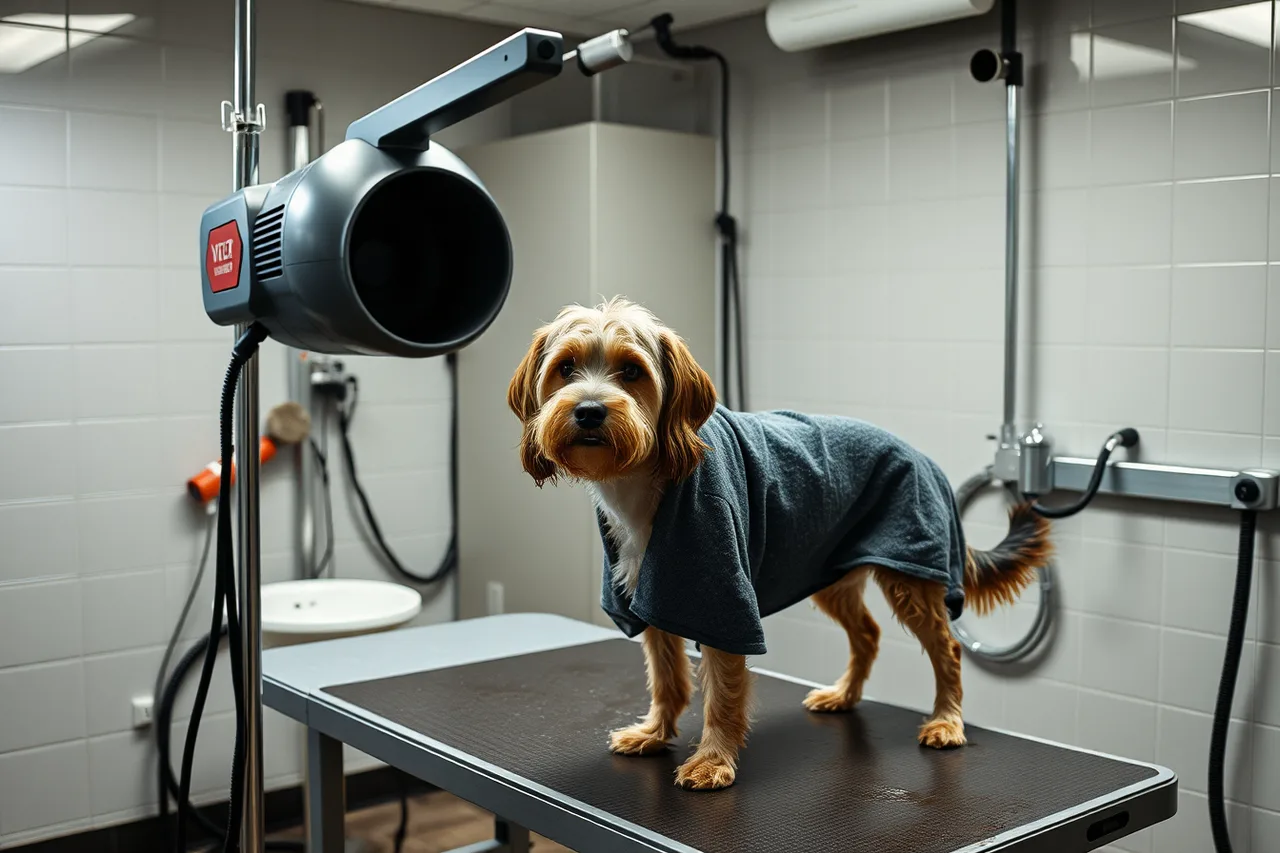
As a typical split of the three, the wet end takes the largest share, because a tub has to be fed, drained and set into a surface that can be washed down. Drying comes next, and the table is usually the smallest of the three lines, though a hydraulic table can cost several times a fixed one.
Buy the drying capacity your worst coat needs, not the one your favorite breed needs. Drying is the stage that turns a full book into a late night, and it is the hardest station to add after the room is built.
Keep the receipts and the service records from the beginning. The Internal Revenue Service explains what records a small business should keep and why the answer is usually more than a new owner expects.
The work the business declines in writing
A new salon that accepts everything is making a promise about animals whose condition it has not seen. Write the refusal list before opening, and post it where clients can read it.
Sensible entries name the situation, not the animal:
Written refusal list
- Coats matted to the skin
- Behavior making safe restraint impossible
- Skin, ear, nail or eye conditions
- Record, stop, tell owner, refer to vet
A short version of the list:
- "Coat matted to the skinwe clip short rather than dematt, and we quote before we start."
- "A dog that one groomer cannot handle safelywe stop and call you to collect it."
- "Visible sores, parasites or skin infectionwe stop, record what we see and refer you to a veterinarian."
In the third case the groomer records what is visible, stops, tells the owner plainly and refers them to a veterinarian. Nothing in a grooming file is a diagnosis, and no salon should let a client treat it as one.
Licensing sits on the same shelf. California sets no state license for groomers at all, so a salon there answers to the city or county business license office and, if it boards dogs overnight, to a kennel permit.
New York City requires a permit for a pet grooming establishment from the New York City Department of Health and Mental Hygiene.
Confirm what applies with your state and municipal authority before you sign a lease, not after.
Common questions
Does a grooming business need a physical salon to start?
No. A mobile unit or a rented chair can carry a first year, and both let an owner learn the coat mix of a service area before committing to a lease. What they cannot do is give you station count. If the plan depends on running two or three dogs through overlapping stages, that plan needs a room.
How much of the first year should be spent on equipment?
The honest answer is a proportion rather than a figure, and it is set by which stations you are short of. Cost the wet end and the drying capacity first, then the table, then the hand tools, and treat everything remaining as deferrable. Owners who buy the visible things first tend to buy the drying capacity twice.
What should a new owner refuse in the first month?
Refuse anything that cannot be finished safely within the booked appointment. That includes a coat condition not disclosed at booking, a dog you cannot restrain alone, or a request to work faster than the animal allows.
Turn down these jobs in the first month. That sets the salon's standard afterward.
Where do the numbers for a plan come from?
From your own trial bookings, your own travel times, and your own refusals, recorded in writing over a defined period. Any figure copied from another operation carries that operation's coat mix, staffing, rent and hours, none of which are yours. Substitute your values into the arithmetic above and mark clearly which inputs are still guesses.