Guides
Pet grooming quote template: how to re-quote at intake
A pet grooming quote template for the moment the comb check changes the figure: extra minutes, the owner's agreement, the record and what voids a quote.
What to take away
- The booking quote is a baseline. The intake re-quote is what settles the argument at collection.
- Set the extra minutes with a comb, in front of the owner, with a photograph on the record.
- The confirmed quote is the booking figure plus the rate multiplied by the extra minutes.
- Give the revised total before any water touches the dog, and write both figures down.
- A quote that changes between booking and intake is normal in this trade. A quote that changes silently is not.
Why the booking quote is only a baseline
A quote given at booking describes a coat nobody has touched, so it can only be a baseline. The re-quote at intake is where the real figure is set, in front of the owner, before the bath starts.
A verbal quote and a written one differ in one way that matters. The written one survives the twenty minutes between drop off and the discovery that the coat is worse than described.
That is why the template below treats the quote as two entries: the figure agreed at booking, and the figure confirmed at intake. The figures used here are illustrative. Substitute your own room rate and your own minutes.
What the booking quote must state
The intake check can only change a figure that was written down first. Each line below gives the comb something to be compared against, so the re-quote reads as a measured difference and not as a new opinion.
| Line on the booking quote | What goes in it | What the intake check does with it |
|---|---|---|
| Coat family | Double, curly or wool, wire, smooth | Confirms the technique and drying demand |
| Size band | Your own band, with the example breed | Confirms the stage minutes |
| Service booked | The menu line, named exactly | Ties the quote to a duration |
| Condition at booking | What the owner described | Is compared with what the comb finds |
| Duration and price | Total length and the first figure agreed | Becomes the base of the re-quote |
| Excluded work | Named, not implied | Removes the collection argument |
Write the excluded work out in full. Work that is implied is work somebody will assume at collection, and the argument that follows is the one the quote exists to prevent.
The owner should see the same lines on the screen, the form or the printout at drop off. A figure the client agreed first is the number the intake check is measured against, and it cannot be argued with later.
The re-quote arithmetic, in two worked cases
The sum has one rule. The confirmed quote equals the booking figure plus the per-minute rate multiplied by the extra minutes the comb check shows. When the extra minutes are zero, the two figures agree, and the client can see that they agree.
Take a small curly coat on a six-week cycle. Say your room rate is $1.20 a minute and the appointment is booked at 90 minutes, so the booking quote is $108. The dog arrives with two mats behind each ear. The comb stops there, you add 20 minutes, and the confirmed quote is $132.
Worked quote figures
- $1.20room rate per minute
- 90 minsmall curly coat booking
- $108booking quote
- $132confirmed quote after 20 min mats
Now take a large double coat, first visit, no cycle history. The booking quote is $150 for 125 minutes, and the quote says the intake check sets the final figure. At intake the undercoat is packed and the drying will run long, so 30 extra minutes are added and the revised quote is $186.
| Dog | Quoted at booking | What the comb found | Extra minutes | Confirmed quote |
|---|---|---|---|---|
| Small curly coat | $108 for 90 minutes | Two mats behind each ear | 20 | $132 |
| Large double coat | $150 for 125 minutes | Packed undercoat, long drying | 30 | $186 |
Both owners agree before the bath, and the reason is told to them in minutes: 20 extra at the same rate, or 30. A figure with a reason is harder to dispute than a figure alone.
The intake conversation, in order
Run the re-quote the same way for every dog, so the owner hears the same sequence each time and the record always has the same lines.
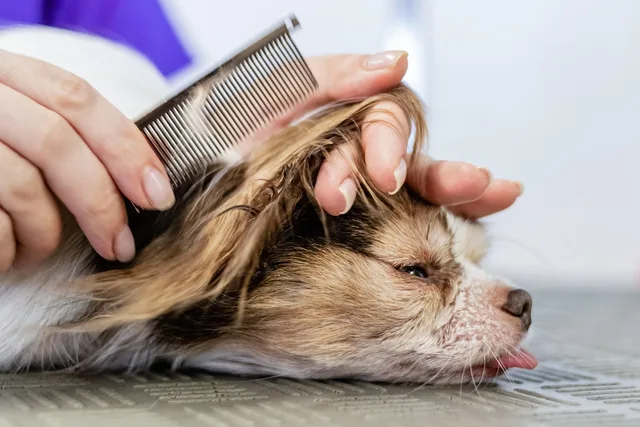
- Comb the coat while the owner is present. A comb that passes to the skin confirms the coat is where it was described.
- Where the comb stops, set the extra minutes there and then.
- Say what you see, and photograph it.
- Give the owner the revised total, with the minutes behind it, before any water touches the dog.
- Write the booking figure, the extra minutes and the confirmed figure on the record, with the owner's agreement.
The intake form is the natural home for those lines. Step three matters most in a dispute, because the photograph shows the coat as it was at the table.
When the comb stops at matting
Matting is the case that tests the re-quote. If the coat is matted to the skin, explain that dematting may take longer than the animal will tolerate, and that the alternative is a shave-down the owner has to agree to.
A shave-down is quoted as its own line, not as a surcharge. It is a different service with a different duration, and the owner agrees to it by name.
Where you see something on the skin, ears, feet or eyes, note it. Tell the owner and refer them to a veterinarian if you are not qualified to assess it. That note is a description, never a diagnosis.
What voids a quote
Print this list on the quote itself rather than keeping it behind the counter.
- Coat family or size band different from the one booked
- Condition materially worse than described, measured by the comb check
- A different service requested on the day
- Work the salon does not perform, requested at intake
- The stopping rule triggered before the appointment is finished
Each of those is a re-quote, not a surcharge added afterwards. The difference is whether the client agreed before the work or was told after it.
The two fields that make the re-quote hold
The stopping rule and the expiry date are the fields most templates omit, and the two that do most of the work. Both belong on the printed quote.
The stopping rule says what halts work and who is called, so the hard case is settled in advance. For a dog the handler cannot settle, the aggressive dog protocol sets out the steps.
The expiry is a date. It stops an old figure being produced months later, because a quote with no expiry will be produced by a client the following season. Then the salon either honors a stale figure or starts the conversation badly.
Keeping the quotes
File every quote with its intake photograph and the appointment record. A disputed collection then becomes a document rather than a memory.
A quarter of quotes read together will show you which menu line is re-quoted most often, which is the line whose description is wrong. Whether the re-quote rate is telling you something about margin belongs with profit margins and break-even, and how the base rate is built is in the station-time pricing formula.
The IRS notes that good records help you monitor the progress of your business, and a filed quote with a photograph is one of those records.
The Bureau of Labor Statistics describes groomers who own a business instead of working at a pet store or clinic. For them the quote is the contract, so the record has to be theirs.
Common questions
Should a quote be given over the phone?
Give the base and the band, and say plainly that condition is confirmed at intake. A phone figure presented as final is a promise made about a coat nobody has touched.
How long should a quote stay valid?
Long enough to cover the booking lead time and no longer. A quote with no expiry will be produced by a client the following season.
What if the comb check finds no extra minutes?
Then the confirmed quote equals the booking quote, and the record says so in one line. Write it anyway. The owner sees that the check happened, and the file shows the same sequence on every dog.
Is a shave-down a surcharge?
No. It is quoted as its own line with its own duration, and the owner agrees to it by name. A surcharge added afterwards is the version of the story that ends in a dispute at collection.
Does a deposit belong on the quote?
Yes, with the terms beside it. A deposit mentioned only in a booking confirmation is a term the client did not read at the moment they were deciding.
What if the owner disputes the intake re-quote?
Show the photograph and offer the alternative service that fits the original figure. Then record what was agreed. An owner who declines both is entitled to take the dog home, and that outcome is cheaper than an argument at collection.