Guides
Pet Grooming Pricing: A Station-Time Cost Formula
Pet grooming pricing can use station time, direct consumables, fixed costs, and available hours to set a cost floor for each appointment.
What to take away
- Pet grooming pricing starts with a claim about duration. Time the duration first and the price follows.
- Coat family and size set the base appointment. Condition on the day is a third variable and belongs on its own line.
- Four pricing shapes are common, and they differ in what happens when a dog arrives worse than booked.
- The margin leaks at the drying station rather than at the table, because drying holds a station while nobody is billing.
- Two weeks of stage timings say more about your prices than any survey of what nearby salons charge.
- Test a proposed price list against a week that already happened before it goes on the wall.
- This method does not prescribe a figure. Every number below is a letter you fill in from your own book.
A salon that raises every line by the same amount has not changed its pricing. It has changed its menu and left the reason underneath untouched. The reason underneath is time: what a dog of a given coat, size and condition occupies in a room with a fixed number of stations.
Most salons price by looking sideways. They find the salon down the road, sit slightly under it, and learn a year later that the other salon books forty minute appointments while they book seventy.
What a grooming price is actually made of
Three things decide what an appointment costs you, and only one of them appears on most menus.
What Sets the Price
Coat family: technique and drying demand
Size: time and lift
Condition: unknown at booking
Coat family sets the technique and the drying demand. Size sets how long every stage takes and whether one person can lift and hold the animal. Condition on the day is the third, and it is the only one nobody can know at booking.
A price built from the first two works until a dog arrives with a coat that has been left. Then the salon either runs late or has a conversation it did not prepare for.
Measure the appointment before you price it
Time each stage separately, on your own dogs and in your own room. The stages are bath, dry, table, finish and handover. Record the coat family and the size band beside every timing.
Time Each Stage
- Bath
- Dry
- Table
- Finish
- Handover
Do this for at least one dog in every combination on the menu. A timing sheet with nine rows beats an industry figure with none, because the nine rows are about your dryers and your tub. The services and packages guide sets out the coat families the timings sort into.
Then find the stage where a second dog waits. That stage is what you are really selling.
Run the sheet for two working weeks. Every dog gets one line with coat family, size band as booked, stage minutes, condition noted at intake, and whether the appointment overran.
If the book is thin, run it until every family and band you sell has at least three dogs in it.
Turning the timings into size bands
Sort the completed lines by coat family. Inside each family, plot total minutes against size and look for where the minutes step up rather than drift. Those steps are your bands.
Give each band a definition the front desk can apply without a scale, and put a named example breed beside it so two bookers agree. A band nobody can apply at booking gets applied at the table, which is too late. For example, a salon might use a Shih Tzu as a small-band reference and a Standard Poodle as a larger-band reference, then set its own band definitions from observed timings; neither breed is a universal cutoff.
Write the definition on the booking screen, not in a manual, and name the drying demand beside each band. Record the band booked and the band that was correct, so disagreement is measurable. Where the two disagree often, the definition is wrong, so fix the definition rather than the bookers.
The four pricing shapes, compared
How it is quoted
- Flat price per coat family
- One figure per family, size ignored
- Coat family and size band
- A grid of family against size
- Timed rate
- A rate applied to measured minutes
- Base plus condition line
- Base from the grid, condition added at intake
What happens when a dog arrives worse than booked
- Flat price per coat family
- The salon absorbs the difference
- Coat family and size band
- Absorbed, unless a condition line exists
- Timed rate
- Handled automatically
- Base plus condition line
- Handled, and visibly
Where it strains
- Flat price per coat family
- Large dogs subsidised by small ones
- Coat family and size band
- Needs an honest size definition at booking
- Timed rate
- Clients dislike an open ended number
- Base plus condition line
- Requires the conversation to happen at the counter
The last shape asks the most of the front desk and gives the most back. It is the only one that puts the surprise in front of the client before the work starts.
Four Pricing Shapes
Flat per coat family
- Quoted as
- One figure
- Worse dog
- Salon absorbs
- Strain
- Large subsidised
Family and size band
- Quoted as
- Grid
- Worse dog
- Absorbed
- Strain
- Size definition
Timed rate
- Quoted as
- Measured minutes
- Worse dog
- Handled
- Strain
- Open number
Base plus condition
- Quoted as
- Base plus add
- Worse dog
- Handled visibly
- Strain
- Counter talk
Condition is a separate variable from coat
Matting is the case that breaks a grid. A coat that has gone past brushing takes work with no relation to the trim booked, and it can take longer than the dog will stand.
Condition cannot be booked. It is first seen when the dog is in front of you, so the person holding the comb sets the price for it at intake. Give that person a written scale and the authority to apply it.
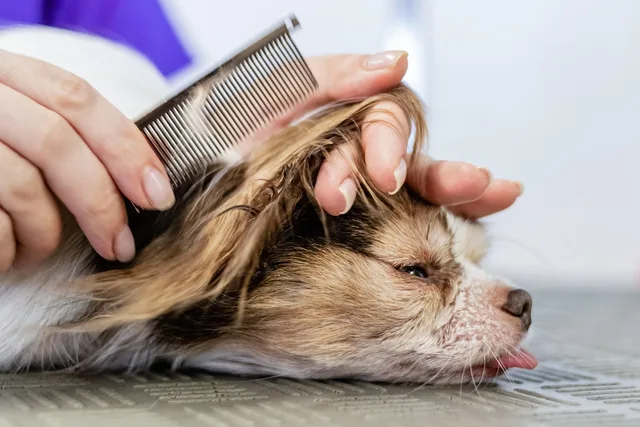
A comb that passes to the skin is the check that settles whether the coat is where the owner said it was.
Assess it at intake, with the owner present, and photograph what you are describing. Where a coat is matted to the skin, say plainly that dematting may exceed what the animal will tolerate and that the alternative is a shave down. That alternative is the owner's decision, taken before work starts, and recorded.
Nothing in that conversation is a judgment about the animal's health. Where something is visible on the skin, ears, feet or eyes that you are not qualified to assess, note it, tell the owner and refer them to a veterinarian.
Where the margin actually leaks
Look at the drying station before you look at the price list.
Drying holds a station for a stretch while the groomer may do something else. That makes it invisible in any model built on labor hours. If a dog cannot be dried while another is on the table, the drying minutes belong to the appointment as much as the scissoring minutes do.
The equipment and setup guide explains why that station is the one most often bought twice.
The second leak is rework. A coat declared dry on the surface produces a finish that does not hold, and the return visit is unpaid table time attributed to nothing.
The cost-based pricing formula
Write the floor as letters and refill them whenever a cost changes.
- D, the minutes an appointment occupies a contended station, drying included
- C, the direct consumables it causes, including a share of blade sharpening
- F, the fixed monthly commitments that run whether or not a dog is booked
- H, the contended station hours available in a month
Cost per station hour is F divided by H. The floor for one appointment is C plus that figure multiplied by D over sixty. A price below the floor is a decision to fund the appointment from something else, which is allowed if you know you are doing it.
Substitute your own values, and rerun the arithmetic in the heaviest coat season rather than a quiet month. The startup and market guide covers where H comes from while the room is still being planned.
Test the price list against a week that already happened
Before publishing anything, run the proposed list backwards over a real week that already happened. Value each appointment at the new price and check the total against the hours that week actually used. Where the week would have lost money, the list is wrong before it is on the wall.
Rerun the study when blade sharpening, product or drying costs move, not on an annual calendar.
What a price may not claim
A saving has to be measured against services you genuinely sell separately at those figures. A duration on a menu has to be one the salon can meet. The Federal Trade Commission's advertising guidance for small businesses sets the general standard for substantiating a claim.
Keep the timing sheets, intake photographs and booking records the prices were built from, along the lines the Internal Revenue Service sets out in its note on what records a business keeps. Registrations that attach to charging for this work at all are a separate matter, handled in the licensing and compliance guide.
In New York City, the Small Animal Grooming Establishment Permit is issued by the Department of Health and Mental Hygiene (DOHMH).
For a plain description of the occupation to put in front of a lender, the Bureau of Labor Statistics profile of animal care and service work is fair. The Small Business Administration guide covers the structure the pricing sits inside.
Common questions
Should size be measured by weight or by coat volume?
By whatever your team can judge at booking without a scale. Many salons use a size band with a named example breed beside it. What matters is that two people booking the same dog put it in the same band.
Is a timed rate fairer than a fixed price?
It is more accurate and harder to sell. Clients want to know what they will pay before they leave the dog. A base with a stated condition line gets most of the accuracy without the open ended figure.
How often should prices be reviewed?
Whenever the timings move. Coat mix drifts with the seasons and with the clients you acquire, and a grid built on last year's mix will be wrong in the same direction for months before anyone notices.
What if a competitor is visibly cheaper?
Time their appointment length instead of matching their figure. A shorter appointment at a lower price is a different product. A salon that matches the price without matching the duration has agreed to do more work for less.