Guides
How to price grooming services in Los Angeles, Houston, and Miami
Grooming prices in Los Angeles, Houston, and Miami differ by wage floor, rent, and local demand, so each metro needs its own rate sheet and client strategy.
What to take away
- One national sheet failsa medium-dog full groom sells for roughly $110 to $135 in Los Angeles, $70 to $90 in Houston, and $90 to $115 in Miami.
- Labor sets the floor before rent does. Time the groom, the bath, and the dry, then price the minutes.
- Houston sells frequency, Los Angeles sells finish work, Miami sells winter packages to seasonal residents.
- Los Angeles add-ons carry the most margin, Houston tickets carry the most dogs per day, Miami bundles carry the winter.
- Raise prices 5 to 8 percent on a posted date instead of in one jump after two flat years.
Why three price sheets beat one
A medium poodle groom that sells for $120 in Los Angeles sells for $75 in Houston on the same Tuesday. Nothing about the dog changed. The rent per square foot, the wage you must pay to keep a groomer, and the insurance premium all changed.
Metro price and cost benchmarks
Los Angeles
- Cost of living index
- 135-145
- Full groom, medium dog
- $110-135
- Full groom, large dog
- $140-175
- Loaded groomer cost/hour
- $32-42
- Main demand driver
- Premium, style-led
- Best margin lever
- Add-ons
Houston
- Cost of living index
- 100
- Full groom, medium dog
- $70-90
- Full groom, large dog
- $95-120
- Loaded groomer cost/hour
- $24-30
- Main demand driver
- Humidity, frequency
- Best margin lever
- Volume, density
Miami
- Cost of living index
- 105-112
- Full groom, medium dog
- $90-115
- Full groom, large dog
- $120-150
- Loaded groomer cost/hour
- $26-34
- Main demand driver
- Year-round coat care
- Best margin lever
- Seasonal packages
A single sheet loses money in one city and prices you out of the other two. Build the sheet city by city, starting from the wage table for that metro.
The Bureau of Labor Statistics publishes the regional wage and cost data behind the gap. Its geographic breakdowns cover metro areas, so you pull Los Angeles, Houston, and Miami figures instead of guessing. Every adjustment below starts there.
Los Angeles
- Cost of living index, Houston = 100
- 135 to 145
- Full groom, medium dog
- $110 to $135
- Full groom, large dog
- $140 to $175
- Loaded groomer cost per hour
- $32 to $42
- Main demand driver
- Premium, style-led clients
- Best margin lever
- Add-ons and upgrades
Houston
- Cost of living index, Houston = 100
- 100
- Full groom, medium dog
- $70 to $90
- Full groom, large dog
- $95 to $120
- Loaded groomer cost per hour
- $24 to $30
- Main demand driver
- Humidity and grooming frequency
- Best margin lever
- Volume and route density
Miami
- Cost of living index, Houston = 100
- 105 to 112
- Full groom, medium dog
- $90 to $115
- Full groom, large dog
- $120 to $150
- Loaded groomer cost per hour
- $26 to $34
- Main demand driver
- Year-round coat care, seasonal residents
- Best margin lever
- Seasonal packages
Los Angeles holds the deepest pool of premium owners. Density is high, competition is heavy, and clients expect a finished look. That includes breed-standard trims, hand scissoring, teeth brushing, a written report card.
Houston has a large pet population and a humid climate that pushes grooming frequency up. Dogs need more baths and more de-shedding, and small salons meet lighter regulatory friction than many coastal cities. Volume is the lever, not ticket size.
Miami runs on a tropical calendar. Coat care is a year-round need, and the market carries a strong luxury segment alongside bilingual clientele. Demand does not vanish in winter; it changes shape when seasonal residents arrive.
If you are still weighing markets before you sign a lease, the analysis in choosing where to open covers how demand and cost interact across metros.
Los Angeles: tiered menu, add-on margin
Los Angeles rewards three tiers: an entry bath and tidy, a core full groom, and a hand-scissored finish that carries the premium. Add-ons do the rest.
Los Angeles service prices
- Bath and tidy$55-70
- Full groom, small$85-105
- Full groom, medium$110-135
- Full groom, large$140-175
- Hand-scissor finish$25-40
- De-shedding treatment$20-35
- Nail trim, standalone$18-25
| Service, small to medium dog | Los Angeles price |
|---|---|
| Bath and tidy | $55 to $70 |
| Full groom, small | $85 to $105 |
| Full groom, medium | $110 to $135 |
| Full groom, large | $140 to $175 |
| Hand-scissor finish | $25 to $40 |
| De-shedding treatment | $20 to $35 |
| Teeth brushing | $12 to $18 |
| Nail trim, standalone | $18 to $25 |
Your wage floor comes from the market, not from what you paid yourself five years ago. The Occupational Employment and Wage Statistics program publishes wage tables for animal care occupations, groomers included, broken out by area. Pull the current Los Angeles metro table before you set a ticket.
As a planning figure, budget a loaded groomer cost of $32 to $42 an hour once wages, payroll taxes, and workers' compensation are counted. A bather runs roughly $22 to $28. The broader outlook on animal care and service workers shows where employment in this field is heading.
Rent is the second cost that defines the sheet. A storefront on a busy retail block carries a rent per square foot that a home-based or mobile setup avoids. Mobile work trades that rent for fuel, vehicle wear, and drive time between appointments, and the ticket has to carry all three.
Competition is not only other salons. It includes mobile units, veterinary clinics with grooming arms, and independent groomers working from converted garages. Price against the service level you deliver, not the cheapest post you can find.
A worked example shows the arithmetic. A medium-dog full groom takes 90 minutes of groomer time and 20 minutes of bather time, with $12 in shampoo, conditioner, and finishing product.
If loaded labor runs $38 an hour for the groomer and $22 for the bather, labor is $57 and supplies are $12, or $69 before rent, insurance, and card fees. A $120 ticket leaves a real margin; a $90 ticket leaves almost nothing. That arithmetic is the core of pricing pet grooming services so the margin survives.
Houston: volume, humidity, and the local health authority
Houston is a volume market. Clients compare you to the shop down the street, and that shop is often cheaper than anything in Los Angeles. Your ticket has to sit close to the local norm while your schedule stays full.
Houston service prices
- Bath and tidy$35-45
- Full groom, small$55-70
- Full groom, medium$70-90
- Full groom, large$95-120
- De-shedding treatment$15-25
- Nail trim, standalone$12-18
| Service, small to medium dog | Houston price |
|---|---|
| Bath and tidy | $35 to $45 |
| Full groom, small | $55 to $70 |
| Full groom, medium | $70 to $90 |
| Full groom, large | $95 to $120 |
| De-shedding treatment | $15 to $25 |
| Teeth brushing | $8 to $12 |
| Nail trim, standalone | $12 to $18 |
Humidity is your ally. A Houston dog needs more frequent baths, more de-shedding, and more attention to skin and ears than a dog in a dry climate. Sell those needs as a maintenance plan rather than a one-off groom, and the same client returns every few weeks instead of every few months.
Business costs in Texas are generally lighter than in California, and the BLS publishes cost data for employers you can use to check your own numbers. Rent, payroll taxes, and insurance still exist, and they still come out of the ticket.
Licensing and sanitation rules vary by state and municipality, and several states require no grooming license at all. The Houston Health Department sets the local health and sanitation context grooming businesses operate under, so confirm current requirements with your state and municipal authority before you open or expand.
Houston margin comes from throughput. A groomer who finishes more dogs per day without rushing quality turns a $75 ticket into a workable margin. That means tight scheduling, a bather who keeps the tub moving, and drying equipment that never bottlenecks the line.
Miami: seasonality and snowbird demand
Miami has no slow coat season, but it has a slow calendar. Summer heat pushes some clients toward shorter cuts and more frequent visits, while winter brings seasonal residents who want full service and are less price sensitive.
Miami service prices
- Bath and tidy$45-60
- Full groom, small$70-90
- Full groom, medium$90-115
- Full groom, large$120-150
- De-shedding treatment$18-28
- Teeth brushing$10-15
| Service, small to medium dog | Miami price |
|---|---|
| Bath and tidy | $45 to $60 |
| Full groom, small | $70 to $90 |
| Full groom, medium | $90 to $115 |
| Full groom, large | $120 to $150 |
| De-shedding treatment | $18 to $28 |
| Teeth brushing | $10 to $15 |
| Seasonal winter package | About 15 to 20 percent off the bundled sum |
Build two sheets: a standard sheet for year-round clients and a seasonal package for the winter rush. Bundling a full groom, a de-shedding treatment, and a nail trim raises the average ticket without cutting your core prices.
Bilingual service is a real advantage here. A salon that can quote, book, and explain aftercare in English and Spanish reaches a larger client base. That staffing capability is a cost, and it belongs in your pricing.
Miami also carries a strong luxury segment. Upgraded shampoos, hand finishing, and spa-style add-ons sell as part of a package rather than a counter upsell. The add-on that feels indulgent in Houston can read as standard in parts of Miami.
Building the sheet, city by city
A price sheet is a cost model with a client-facing cover. Build it in this order.
Build the price sheet
- List every service you sell
- Time each service honestly
- Attach local loaded labor rate
- Add supplies, rent, insurance, processing
- Set target margin, work backward
- Apply cost of living adjustment
- Check against per-service tables
- List every service you sell, from bath and tidy to full groom to each add-on.
- Time each service honestly, including setup, drying, and cleanup, not just the cutting.
- Attach a loaded labor rate to each service using local wage data for your metro.
- Add supplies, rent or vehicle cost, insurance, software, and card processing per appointment.
- Set a target margin, then work backward to the ticket price that delivers it.
Then apply the cost of living adjustment. Index Houston at 100, Los Angeles at 135 to 145, and Miami at 105 to 112. Multiply your Houston sheet by those ratios, then round to the nearest five dollars.
Check the result against the per-service tables above, because a straight multiplier can push a large-dog groom past what the local market will pay. Adjust large-dog and add-on prices by hand.
Aim for a gross margin of 45 to 60 percent on labor-heavy services after supplies and rent, and higher on retail-style add-ons such as paw balm. Anything below 40 percent deserves a price change or a schedule change.
Use a written quote so the client sees the scope, the price, and the add-ons in one place. A quote template with pricing keeps estimates consistent across staff and reduces disputes about what was included.
Review the sheet against actual numbers every quarter. If supply costs rose or groomer pay went up, the sheet is already stale. The wider margin picture, including which services carry the most profit, is covered in pricing a pet grooming business.
- Every service timed with a stopwatch, not an estimate
- Labor rate pulled from the current local wage table
- Supplies costed per appointment, not per month
- Rent, insurance, and card fees allocated per service
- Target margin written down and tested against real tickets
- Cost of living multiplier applied by city, then rounded
- Quote template ready for front-desk staff
Some services carry more margin than others, and knowing which deserve promotion separates a busy salon from a profitable one. The breakdown in profitable pet grooming services is worth reading before you finalize the menu.
Raising prices without losing regulars
Raise prices on a schedule, not when cash gets tight. A 5 to 8 percent annual increase, announced in advance, is easier for clients to accept than a 20 percent jump after two flat years.
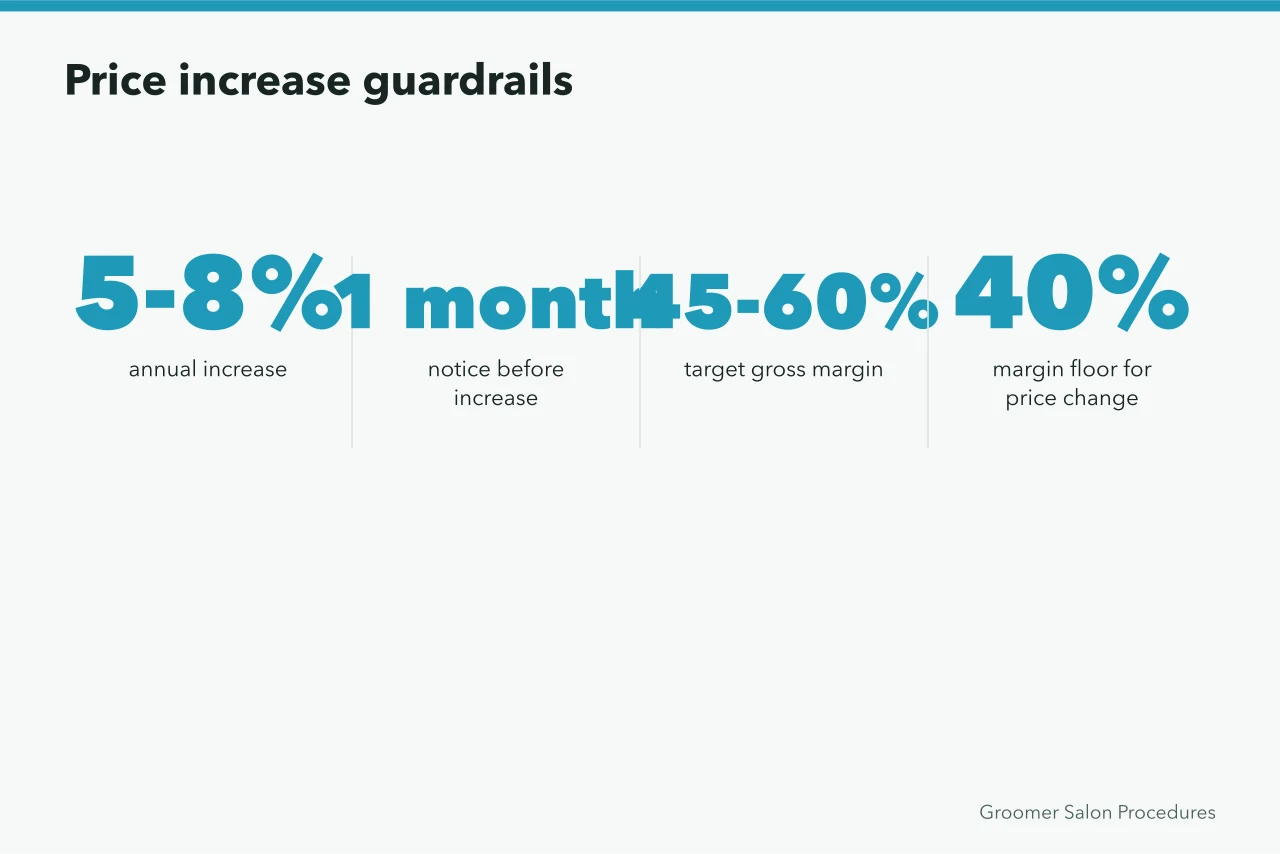
Give notice. Post the new sheet at the counter and email regulars at least a month before it takes effect. Clients rarely leave over a modest increase; they leave when it feels sudden.
Tie the increase to something visible. New drying equipment, a longer appointment slot, a better finishing product, or added aftercare instructions all justify a higher ticket. If nothing changed, the increase is harder to defend.
Watch booking data after the change. If cancellations spike among long-term clients, your increase was too fast. If almost no one reacts, you were underpriced before.
Keep a small loyalty buffer. A modest discount for clients who book their next appointment before they leave protects the regulars who carry your schedule through slow weeks, and it costs less than replacing them.
Common questions
How much should I charge for a full groom in Los Angeles?
Benchmark a medium dog at $110 to $135 and a large dog at $140 to $175. Use the current Los Angeles wage table to confirm the ticket covers loaded labor, rent, and supplies.
Are Houston grooming rates really lower than Miami rates?
Generally yes. A medium-dog full groom runs about $70 to $90 in Houston and $90 to $115 in Miami, though the gap narrows in Miami's slow season and widens with the winter influx.
How do I apply a cost of living adjustment without guessing?
Index Houston at 100, then multiply by 1.35 to 1.45 for Los Angeles and 1.05 to 1.12 for Miami. Round the result and check it against local competitor pricing before you publish.
Do I need a separate price sheet for each city?
Yes, if you operate in more than one of these metros. Wages, rent, and demand differ enough that one sheet will either lose margin or overprice you somewhere.